Showing posts with label inclusion. Show all posts

Wednesday, April 6, 2016

Making Thinking Visible - Math Edition


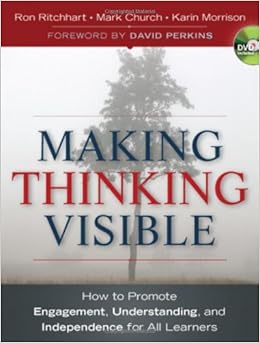
Our school has been reading and attending workshops on Making Thinking Visible.  (You can purchase the book here). The text written by Ron Ritchart, Mark Church, and Karin Morrison contains strategies, or as they refer to them - routines, for getting students to show their thinking.  When we know what and how the students are thinking about a topic, it helps us clarify misconceptions or expand on their current understanding.

Much of our work this year has centered around literacy.  I decided to step outside of my comfort zone, and try one of the strategies outlined in the text called, "See, Think, Wonder" during math.  I used this thinking routine as an opener for a math lesson on line plots.

This thinking routine involves projecting an image, then asking students to name what they see, what this makes them think, and anything they are now wondering.  You can do this aloud as a whole class by writing down their thoughts on chart paper as shown below, or having students complete this routine independently.  I chose to do this as a class because I wanted to see how the students thoughts would build off of each other.  Pictured is the chart that contains the student thinking based on the line plot.  Excuse the messy writing; I was trying to keep up with all of their thoughts!


It can be tricky for students to differentiate between what they see and think.  I often paraphrase what they're saying with, "Oh, so what you're thinking is that..."  Using this routine is a great way to introduce a new topic, and get students thinking about math conceptually.  We want our students to be doing the thinking, after all!

Enjoy!
-Hayley

Thursday, December 3, 2015

Parts of Speech Sort

After spending several weeks teaching parts of speech, we decided to spend one week reviewing some of the concepts previously taught.  The parts of speech we chose as part of our review are nouns, verbs, adverbs, and adjectives.  This can be a lot for students to recall!


One way I reviewed with my students was through a sort.  I wanted my students to really think about what the word was before identifying the part of speech.  To do this, my students drew pictures for each word prior to sorting.  This seemed to really help with their ability to independently categorize the words.  They absolutely loved this activity!  


Included with the sort is a 15 point quiz.  It incorporates definition matching and identifying the parts of speech in a sentence.  You can get it at my TpT store HERE!


Monday, October 12, 2015

Rounding on a Vertical Number Line

We're about to begin our rounding and estimating unit.  Our district utilizes the Eureka curriculum.  I created the reference sheet and worksheets to help my students practice rounding on the vertical number line.  It was a little daunting at first but actually makes more sense than just thinking about the good ole 0 to 4 rounds down and 5 to 9 rounds up.  This is a great strategy for visual learners.  I would recommend sending home the reference for parents and a support at home.


Check it out at my TpT store!  Follow me for more freebies and updates.

Wednesday, September 30, 2015

Multiplication Today


Many parents comment about how math looks very different today.  At a recent School Open House night, we showed a PowerPoint of how math can be modeled.  We are currently in our multiplication unit, where students are learning the concept, not just facts.


As a way of reviewing the various ways to model, I had students represent a fact using arrays, number bonds, the commutative property, and equal groups.  This FREEBIE is great to hang up for an Open House or just review the different ways to model math.


Sunday, September 27, 2015

Action Verb Charades


When teaching verbs in the past, I had students act out the verb to see the action.  We did this for sentences we read to make identifying verbs more accessible for the kinesthetic learners.  While lesson planning this afternoon, I thought of a more engaging way to involve movement into the teaching of verbs - Charades!


This FREEBIE is available on my TpT site for a limited time!

Saturday, September 26, 2015

Irregular Verbs Resource Pack

Each year, many students come from homes where English is not the first language, or even spoken at all.  One area where these students have difficulty, as do many young English speakers, is with irregular verbs.

Our students enter the building between 9:00 and 9:15.  Most teachers don't begin lessons until 9:30.  As a special educator, I see that as plenty of time to run a small group to work on goals!

I created a pack of resources to use to help the students learn some of the irregular verbs.  There are so many to learn but I selected the verbs I thought would be most frequently seen and used.


The pack includes four fill-in-the-blank worksheets, a memory matching game, and a sorting worksheet.  I printed several sets of the memory matching game on different shades of colored card-stock.  I paired the students up heterogeneously so they could help each other recognize matches.


How do you teach irregular verbs?

Saturday, August 22, 2015

Organizing the Classroom Library

We have been back at school getting ready for our new students to show up on Wednesday.  Summer sure did fly by after those seven snow-days were added on to the end of the school year!

One of my major projects this week was rethinking the leveled library in the third grade pull-out space.  Every general education classroom has an extensive library but I wanted to offer some lower level books for students who may not find what they're looking for at their "just right" level in their homeroom classes.  I was able to clear out a few shelves to make a mini leveled library that all students in third grade can access.  It's currently a work in progress, but here's an idea of how I'll be using the space.


This year, I discovered Townsend Press.  They offer a range of leveled books for just $1 each.  The books feature diverse characters and realistic school and home situations that all readers can relate to.


This morning I created book bin labels with clipart I found from Krista Wallden. She has lots of free clip art, fonts, and teaching resources on her TPT site.  My book bin labels include one label per A to Z level, a variety of topics, and all genres.  Snag them for FREE now!


Monday, August 10, 2015

Reviewing IEPs

Do you feel like you could spend a whole year reviewing IEPs?

It seems like that's what I've been doing, gearing up for a new school year.  Although I only have 11 students to begin the year, it seems like a lot.  I typically identify several more in need of individualized instruction during their third grade year.  Last year, I typed up a grid for the general educators that would also be working with identified students.  This helped give a snapshot of what was in each student's IEP.  

Before I go on, I should mention that our school's inclusion model looks like this: one special educator per grade level, all students on IEPs divided evenly amongst the four general education classrooms, and me feeling torn in every direction.  Because of this, collaboration with the other service providers is so crucial.  Luckily, I happen to like everyone I work with!  


It helps to meet frequently with the other providers to ensure you are all on the same page in terms of each child's needs.  The grid that I use is up on my TpT site for FREE.  It can be printed out as is, or typed directly into, depending on what you prefer.  I based this grid on what I find most important in the IEP.  For example, I can get to know their skills through working with them pretty quickly, but might not always remember the specific meeting dates or testing accommodations they may have.  

Feel free to download this for FREE and share with the service providers you collaborate with at school.